
Your app has cavities: what toothbrushing can teach you about accessibility
What if I told you that brushing your teeth once a year is enough to keep them healthy? You’d laugh - because it’s ridiculous. Yet this is how many organisations treat accessibility. They run one audit, fix a few things, check the compliance box, and forget about it until the next deadline. But just like dental care, accessibility doesn’t work that way.
Keeping your teeth healthy requires daily care, the right tools, some knowledge, and regular visits to the dentist. Accessibility is no different.
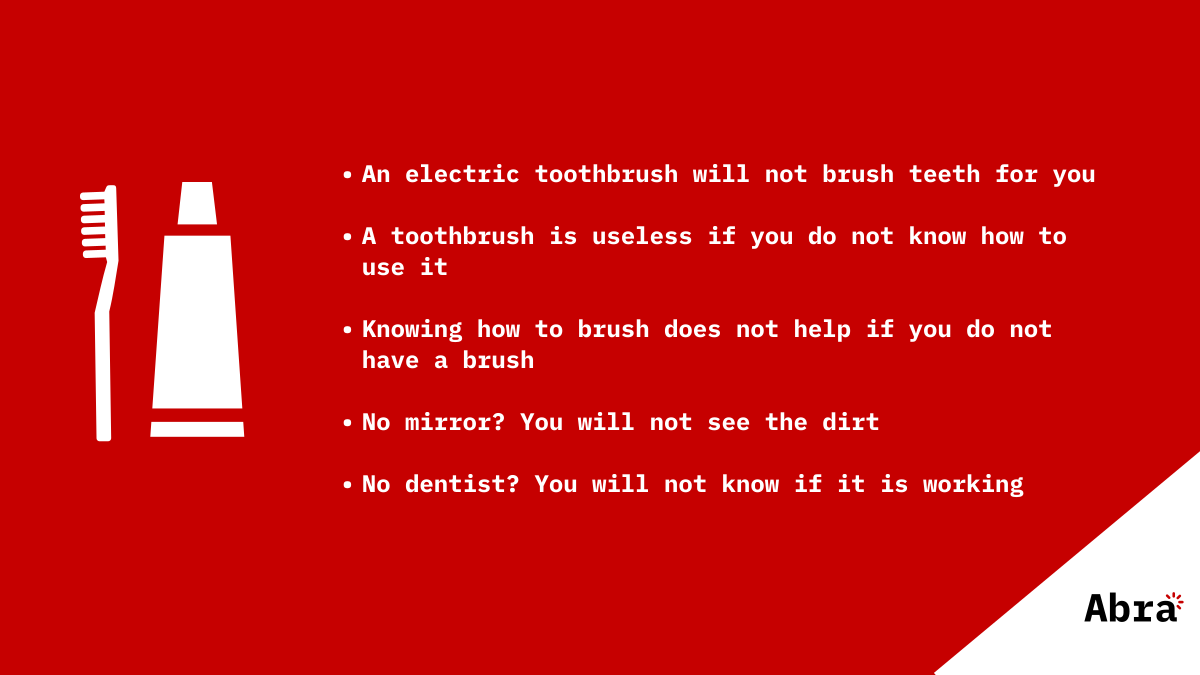
Let’s start with the basics. Imagine you know how to brush your teeth, but you don’t have a toothbrush. Not very helpful. That’s what it’s like when teams understand accessibility in theory but don’t have the tools to apply it. Now picture the opposite: you’ve got a toothbrush, but no idea how to use it. You won’t get far either. It’s the same with accessibility. Tooling without knowledge gets you nowhere.
Even if you have an electric toothbrush - it won’t brush your teeth automatically. Unfortunately. Just like automated testing alone won’t make your app accessible. You also need a mirror to see the dirt. Without it, you won’t notice what’s wrong. That’s what testing is for: without regular testing, accessibility issues stay hidden.
And of course, you still need the dentist - someone who tells you whether it’s actually working. That’s what audits and user feedback are for. Without them, you won’t know whether your app is truly accessible - or where things still go wrong.
So why do we brush our teeth every day - and still struggle to embed accessibility in our teams? It’s because brushing is a habit. We learned it as kids. We do it without thinking. That’s the key: make accessibility a habit. Something you and your team just do. Daily, routinely, naturally.
European Accessibility Act
And while you’re brushing - the European Accessibility Act (EAA) is already in force. It doesn’t just ask for good intentions; it demands action. Not once. Not when it’s convenient. But continuously - as part of how you build, maintain, and improve your services.
Let’s keep it simple. What the legislation requires:
Comply – Develop and maintain accessible services.
Like brushing your teeth every day. Skipping a day now and then may seem harmless, but neglect adds up. Accessibility works the same: it needs to be part of your daily process, not a once-a-year clean-up.
Document – Keep accessibility records for as long as your services run.
Like tracking your brushing habits or having that little calendar your kid sticks a sticker on after brushing. It’s not just about doing it - it’s about showing that you’re doing it.
Maintain – Update processes when your services or the standards change.
Like switching to a softer brush if your gums get sensitive, or brushing longer if your dentist tells you to. Accessibility standards evolve. So should your approach.
Report – Act on issues and report to authorities when needed.
Like going to the dentist when you feel pain - not waiting until it’s too late. If you ignore signs or complaints, it doesn’t just hurt the user; it may soon hurt your business too.
It’s no longer a nice-to-have. It’s the standard. The good news? Just like brushing your teeth became second nature, accessibility can too. It starts with repetition, the right support, and building routines that stick.
Understand where you stand
At Abra, we help teams figure out where they stand with regard to accessibility of the mobile apps. We work with mobile apps - so we built our own App Accessibility Maturity Model to assess how accessibility is integrated into your organisation and how well it’s maintained over time.
We look at six pillars.
Strategy. Do you have goals and a plan? That’s your commitment to healthy teeth.
Processes. Is accessibility baked into design, development, testing, and delivery? That’s your daily brushing routine.
Monitoring. Do you test regularly? Can you compare where you were a year ago to where you are now? That’s your mirror.
Resources. Do you have the right people, time, and tools? Your toothbrush, toothpaste, floss.
Skills and knowledge. Do team members know what to do, and how to do it? Are new people trained? Are learnings shared?
User involvement. Do you speak with people who use assistive tech? Do you know what really matters to them?
Depending on how far you’ve come, your organisation may fall into one of three levels:
Starting: you fix issues when they arise.
Engaged: you have knowledge and partial processes.
Embedded: accessibility is part of your team’s DNA.
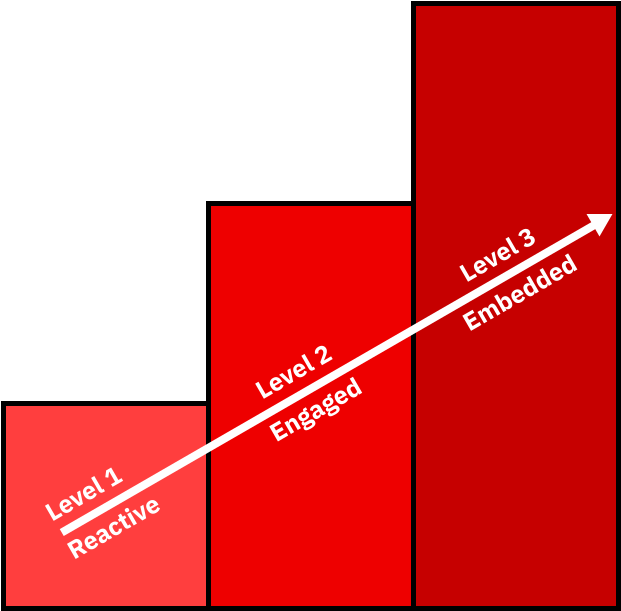
At the embedded level, your app is likely to comply with the European Accessibility Act - because accessibility is no longer a one-off effort, but a continuous practice.
Monitoring
Let’s zoom in on one part: monitoring. Testing. Knowing where you stand.
There are three main types of testing: automated, manual, and user testing. Each has its place.
Automated testing is fast and repeatable. It helps find common issues across many screens. At Abra, we built our own tool - the Abra Desktop - to support this, even without access to source code. It’s a great place to start. But automated testing only gets you about 20% of the way.
Manual testing covers much more. Around 80% of accessibility issues require a human to spot them - especially on mobile. Manual testing takes time. It requires deep WCAG knowledge and experience with assistive technologies. But it’s essential to truly know whether your app works.
User testing brings real insights. Users show you what you’ve missed. They experience your product in ways that standards alone can’t predict. Their input is powerful, practical, and often emotional. Especially for developers - it creates urgency, empathy, and commitment.
All three types of testing have one thing in common: they’re useless without knowledge. You need to understand accessibility to test for it - and to fix what you find.
Our approach
At Abra, our vision is simple. Accessibility is a combination of knowledge, skills, and tooling. And it only sticks when it’s practical, repeatable, and a little bit fun.
That’s why we focus our services and tooling around three clear pillars:
Reproducible test results: Our automated and manual tools detect clear, actionable issues - like your toothbrush, floss, and dental tools that help you keep things clean every day.
Easily solve issues: Every issue comes with a solution - like clear feedback on how to improve your brushing technique and keep your teeth healthy.
Accessibility knowledge: Abra helps teams build the knowledge to solve issues themselves - like a dentist who holds up the mirror and teaches you how to take better care of your teeth.
And once again: add a bit of fun, make it a habit - just like teaching your kids to brush. You’ll benefit every day.
So ask yourself: is your team ready to build accessible products - every day?
If not, we’d love to show you how. Come brush your teeth with us!
Further reading
-
The European Accessibility Act: what businesses and app developers need to know
The European accessibility act (EAA) is European-wide legislation designed to ensure digital products and services are accessible to everyone, including people with disabilities. Unlike earlier accessibility directives targeting public sector organisations, the EAA specifically addresses commercial organisations. The EAA applies to products and services. Read more »
-
EAA compliance: how to write an Accessibility Statement for your app
The European Accessibility Act (EAA) is EU-wide legislation designed to make digital products and services accessible to everyone, including people with disabilities. If you provide digital products or services through a mobile app, you need processes and documentation that demonstrate how accessibility is managed and maintained. You can do this with an Accessibility Statement. Read more »
-
Measuring app accessibility maturity
To meet the legal requirements of digital accessibility, apps need to be accessible for everyone, including people with disabilities. In Europe these are the EAA requirements. What this means, and how to achieve this as an organization, is often less clear. Read more »