

CPACC explained: what it is and how we prepared
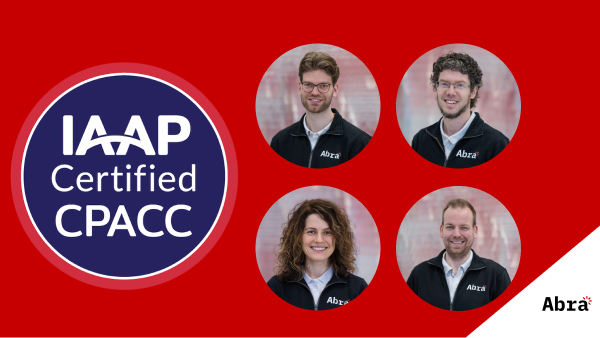
Recently, all four of us passed the CPACC exam and obtained our certification. In this article, we share our experience for people who are preparing for CPACC or considering taking the exam.
 What is CPACC?
CPACC stands for Certified Professional in Accessibility Core Competencies. It is a certification issued by the International Association of Accessibility Professionals.
The CPACC exam assesses foundational accessibility knowledge. It is deliberately broad and covers much more than digital accessibility alone.
The exam covers topics such as:
Disability types and functional limitations
Assistive technologies and how people use them
Accessibility principles and models
Standards and guidelines, including WCAG
Laws, policies, and regulations
Statistics, demographics, and historical context
Accessibility beyond digital products
In short, CPACC validates that you understand the core concepts, terminology, and context of accessibility, rather than whether you can audit a website or an app.
Who CPACC is for and why we did CPACC as a team
CPACC is well suited for people who manage, coordinate, or support accessibility. You may not design, build, or audit accessible products yourself, but you need to understand accessibility well enough to make informed decisions.
The certification demonstrates broad, cross-disciplinary knowledge about disabilities, accessibility and universal design, and accessibility related standards, laws, and management strategies.
We work with accessibility daily, both in theory and in practice. CPACC gives official and independent proof of that expertise. Passing the exam together shows that accessibility knowledge is embedded across our team and not dependent on a single specialist.
How we prepared for the CPACC exam
1. Official CPACC Preparation Course
All four of us followed the official CPACC Exam Preparation Training Course offered by IAAP. The course highlights the topics that matter for the exam and helps structure your learning.
The real value of the course is that it reflects how IAAP frames accessibility concepts and how questions are asked in the exam. For active IAAP members, the course is free.
2. Practice exam
The practice exam, included in the preparation course, is extremely valuable. It gives a realistic sense of the exam format, the level of detail, and the type of reasoning expected.
Do not just check your score. Go through every incorrect answer and understand why it is wrong.
3. CPACC Body of Knowledge
The CPACC Body of Knowledge document is the foundation of everything. It is compact and dense. You need to understand it, not skim it.
4. How WCAG fits into CPACC preparation
WCAG knowledge is required, but not at implementation level.
Because we work daily with WCAG, both in theory and in practice, this part required little additional study for us. We already understand why WCAG exists, how it is structured, and how it connects to broader accessibility principles.
If you do not work regularly with WCAG, plan extra study time. Focus on understanding WCAG conceptually.
5. Additional courses by third parties
If you already work as an accessibility practitioner, the official preparation course, practice exam, and Body of Knowledge should be sufficient.
Start with these resources first. Only look for additional third party courses if you identify specific gaps in your knowledge.
CPACC exam structure
The CPACC exam consists of:
100 multiple choice questions
Two hours to complete the exam
Computer based and closed book
Additional time can be requested as an accommodation
The certification assumes at least one year of experience in accessibility or a role with some responsibility for accessibility.
Our practical tips for CPACC preparation
Take the necessary time based on your experience and accessibility knowledge. Some parts of CPACC are about understanding concepts. Others require real memorisation.
Based on our experience, spend focused time on memorising:
Accessibility-related statistics and demographics
Laws, policies, and regional legislation
Key models, definitions, and terminology
Make notes, repeat them, and learn them properly. There is no shortcut here.
What we enjoyed most
Preparing for CPACC was genuinely interesting. It goes beyond digital accessibility and places our daily work in a broader social, legal, and human context. Even if you already work in accessibility, that perspective adds real value.
What’s next
We will soon be launching a mobile app accessibility course in collaboration with the International Association of Accessibility Professionals.
The official announcement will follow within the next couple of weeks.
This upcoming course will focus specifically on accessibility of mobile apps and is aimed at professionals who want to deepen their practical knowledge beyond foundational accessibility concepts.
Continue learning with Abra
CPACC proves foundational accessibility knowledge. Real expertise comes from applying it in practice.
That is exactly what the Abra Academy focuses on. We offer e-learning trainings that go deep into mobile app accessibility. These courses are designed for auditors, developers, designers and testers who want to understand and improve accessibility of iOS and Android apps:
By completing five Abra courses (including the free online kick-off training), you can earn 4.75 IAAP education credits.
Prefer to start live? Join one of our free online mobile accessibility trainings.
Accessibility knowledge grows through practice. Abra helps you get there faster.
Further reading
-
Who gets left behind when apps ignore accessibility?
We often think of disability as something fixed and distant. But the truth is: we all face limitations, sometimes lifelong, sometimes for a short period, sometimes simply because of the situation we are in. If your mobile app works only for “ideal” users in “ideal” conditions, you will leave many people behind. Read more »
-
Practical guide to mobile accessibility testing
If you are a developer, designer, tester, auditor or any other professional already working on accessibility but unsure how to approach mobile accessibility testing by hand, this guide is for you. Read more »
-
Your app has cavities: what toothbrushing can teach you about accessibility
What if I told you that brushing your teeth once a year is enough to keep them healthy? You’d laugh - because it’s ridiculous. Yet this is how many organisations treat accessibility. They run one audit, fix a few things, check the compliance box, and forget about it until the next deadline. But just like dental care, accessibility doesn’t work that way. Read more »